Progress! Delicious progress! Since the start of the year, I really hit my stride with the art. The quality of my work skyrocketed as well. Both things, incidentally, coincided with my daughter finally sleeping through the night. What wonders a good night's rest can do!
The increased speed let me both get ahead with the art, AND gave me time to experiment with mediums. I tried doing a finished piece on yupo "paper", which is actually a plastic surface intended for watercolor. But as it turns out I emphatically don't like the way watercolor behaves on it. And worse, India ink erases right off! So, that spread became just a really detailed sketch, complete with ugly pencil lines that I can't remove without trashing the inked lines.
Oh well - it isn't as bad as that time in college when one of my classmates sprayed a finish coating of quick-drying varnish on a gorgeous, completed painting - and then dropped a protractor on it. The protractor stuck tight and the painting became an instant collage.
I did finally settle on India ink art markers to draw my lines. The brush-tip combines some of the best quality of brush and Sharpie, which I have to admit I've developed quite a liking to, despite the smell.
So, in the art department, I am ahead of schedule. However, wah wah wah. . . I now have a change of plans. The SCBWI Spring Conference, as it turns out, coincides with our family vacation. After my howls of outrage, I decided instead to attend one of the upcoming international conferences. And there is also an upcoming portfolio review being given by SCBWI member Ruth Sanderson in May. If I can get in to it, I'll go. But it is a portfolio review, so as of now I am dropping everything in favor of getting a portfolio put together. Seeing as I needed to iron out my watercolor technique anyway, this works out perfectly.
My typical goals, listed in order of importance, look like this:
-Sketch four dummy book pages. OR draw, ink, and stretch paper for two paintings. OR finish two paintings.
-Visit the library to pick up books.
-Order the next week's quota of library books.
-Contact one children's book industry professional.
-Write one blog entry.
Despite a little holiday slacking on the bottom items, I've been reasonably on-target.
As for industry professionals, I have now gone to hear two local writers read at the local Barnes and Noble. But I won't sully the upbeat note of this update with my report on that.
Instead, I will report that I have a big win: I have joined the Holliston Writer's Group! I can't believe how hungry I have been for the company of people who are doing the same crazy thing as me. It's not really a critique group, but more of a moral-support-and-tip-swapping thing. Loads of useful information was shared at this month's meeting. I felt like I was contributing at least as much as I was getting, which makes me feel competent and useful. And that makes me feel confident! I really look forward to going back.
Wednesday, January 23, 2013

Wednesday, January 2, 2013
New Year's Resolutions? Hah! I Have a Schedule!
Between Christmas, my parents coming for a visit, weaning my daughter, getting shingles (not the kind that go on the roof), and a household cold that necessitated nebulizing my son, I have accomplished both diddly and squat in the art department. But since I planned on getting nothing done over the holidays, it appears that I am still right on schedule!
Over the holidays my mother reunited me with a favorite book from my childhood: Jolly Old Santa Claus, illustrated by George Hinke. And Chris gave me two books by my new favorite author: Dog Breath, and Wellington's Rainy Day, both by Carolyn Beck. Stay tuned for reviews of all three.
With any luck, I will have the Christmas detritus removed from my studio in time for me to resume work on my dummy book this weekend. And with that, I must depart for bed, because I have a date with an angry toddler sometime after one.
Tuesday, December 11, 2012
I can draw!

My studio space. The white rectangles are pages of the final dummy book to be filled. Eight now contain drawings.
Every so often I seem to forget and then rediscover that I can, in fact, draw. This time, wow, it's crashing back on me in a glorious tsunami!
Taking the time to work out dragon anatomy and character faces has paid off tenfold. Need another dragon in the background to round out the composition? Move the main figure over a half inch? No problem! Did you know that dragons have a thumb on their wing? It's usually tucked underneath. Or that they have belly buttons? Shhh, they're mammals, but don't spoil it for the kids. (But don't ask me where the dragon nipples got off to.)
With that hurdle out of the way, I faced another problem: a reoccurring location is a page-filling heap of trash. It is practically a character. And try as I might, I can't seem to fake it. I'm just not good at doodling some shapes around the edge that suggest that the entire space is filled with objects. No, when I get going, I obsessively render every water bottle and broken cell phone. And I'll have to redraw this heap at least five times.
But you know what? Drawing a million pieces of trash is insanely fun! And also, I'm getting faster and faster at it. The first pile was excruciating, and had to be plotted out carefully in pencil first. By the third one, I was flying by the seat of my pants, going straight at the blank sheet with pen.
As a reward to myself for getting such a reaction from Chris (who is, after all, a former art director) I went shopping online for archival watercolor paper.
Sunday, December 2, 2012
Polar Express? Bah Humbug.

I began the Christmas fun for my kids this morning by bringing down the Christmas boxes from the attic. We arranged nutcrackers, ate some chocolates from their very first advent calenders, and set up The Train.
Oh, The Train! It's a beautiful working model of the train from the Polar Express movie, courtesy of his awesome grandparents. My four-year-old son waited since last December with a patience well beyond his years to play with it again. I suppose we will have to have a showing of "the train movie" at some point this month, seeing as it is Christmas and he just had to watch it again and again when he went through that obsessed-with-just-one-movie stage of three.
If you hear some reluctance in my words, you aren't imagining things. I'm sure there are plenty of parents who would prefer not to be subjected yet again to the movie's eerie, almost-real art style. But that isn't what turns me off of the movie.
Back when I wrote about the Giving Tree, a friend wrote to me in private to tell me how she loathed the book, but how she was afraid to tell me so in public on Facebook. She knew that there are many people who love that particular book, and among them some who cling fiercely and emotionally to the Giving Tree. She was afraid to risk their ire.
I feel similarly about the Polar Express. Reviews churn with frothy love for this book. I am hard pressed to find any negative opinion of Chris Van Allsburg's masterpiece anywhere on the internet - and isn't the internet the source of all things cynical? Among the few negative reviews I can find, I still seem to be alone in the source of my dislike. Worse yet, in terms of setting myself to be scorned by those who love the book, is that I dislike the Polar Express for the very reason that it is so frequently beloved:
At one time, most of my friends could hear the bell, but as years passed, it fell silent for all of them. Even Sarah found one Christmas that she could no longer hear its sweet sound. Though I've grown old, the bell still rings for me, as it does for all who truly believe.I must have been seven or eight when I first encountered this book. Even then, I was struck with the tragedy of children growing up and becoming dim-witted adults who would not or could not see the beauty around them.
Now, as I watch my son explore his surroundings, I am floored at his inquisitiveness. When he encounters something new, he wants to know what it is made of. How it works. What it does. What it means. He is filled with wonder and a drive to observe. And every answer he gets makes him more excited, and spurs him onward to two more questions. Excited questions! My son sees the beauty of the actual world around him, and the more he learns about it, the more beauty he sees.
His zest for life isn't based on some fairy tale that is going to pop like a soap bubble and leave him feeling stranded and in need of a train to the North Pole. Every layer of truth that he learns leaves him more fulfilled, not less.
You might wonder at my own childhood Christmas experience. It went like this: whenever my father talked about Santa, he had that crooked little smile that indicated he was playing a game. He wasn't lying; he was playing pretend, and waiting for me to catch on. I did catch on, early, and I played along, eagerly and joyfully. I can recall being seven, on Christmas Eve, listening for the sound of hooves on the roof, even though I already knew that my parents were hiding all the presents somewhere.
Why as a culture do we insist that our children believe in something that we do not? Why to we place such value on childhood ignorance and vulnerability to falsehood? Why do we set them up to be crushed by a reality that is drab compared to the shiny lie we have fed them?
Why, as a society who supposedly values scientific inquiry in adults, do we teach our children to place a premium on belief without evidence?
Tuesday, November 27, 2012
Oh, Those Gay Penguins!
My one-year-old pulled two books from the library shelf at random for me this week. As it turns out, both books are about homosexual penguins.

Now THIS book really is about gay penguins! And what a wonderfully sweet book it is. Based on a true story, two male penguins in the Central Park zoo court each other and build a nest. A zookeeper gives them an egg to hatch, and the resulting fluffy chick is named Tango. The end, happy happy.
Being as this is a picture book about a homosexual relationship, And Tango Makes Three, by Justin Richardson and Peter Parnell, was the most challenged book of 2006, 2007, 2008, and 2010. It was the second most challenged book of 2009.
I read this to my four-year-old. His only point of confusion: "what's a penguin house, mommy? I thought they lived in a nest. Where is the house?"
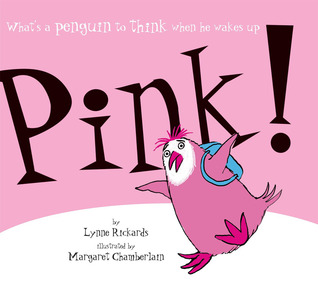
Well, no, not really. He's just pink. I suppose this penguin could be gay, but the book doesn't go there. Too bad.
Anyway, in What's a Penguin to Think When He Wakes Up Pink, sweet little penguin Patrick wakes up a new and interesting color. His friends tease him, so he runs away to Africa to meet pink flamingos. Due to him being a short-legged and flightless penguin, he doesn't fit in well with the flamingos. So Patrick swims home again, only to find that his friends all think he is awesome now because he went all the way to Africa and met flamingos.
It's a heartwarming story about how it can be both challenging and neat to be different, and about how boys shouldn't fear the color pink. I would classify it as too uncontroversial for my collection of dangerous books, but I actually did once overhear a parent at a daycare scold their son not to play with the tea set. I'm sure that such a parent would disapprove of Lynne Rickards' sweet pink penguin tale, so for them, I add Pink to my library.
Being as this is a picture book about a homosexual relationship, And Tango Makes Three, by Justin Richardson and Peter Parnell, was the most challenged book of 2006, 2007, 2008, and 2010. It was the second most challenged book of 2009.
I read this to my four-year-old. His only point of confusion: "what's a penguin house, mommy? I thought they lived in a nest. Where is the house?"
Sunday, November 25, 2012
Children's Books that Lack Happy Endings
For today's disturbing-and-fascinating children's literature, I present two parables.


Given my parents' love of Shel Silverstein, I am surprised that I never read this one as a child. Lafcadio, the Lion Who Shot Back, by Shel Silverstein is practically an illustrated children's novel, at well over 100 pages
Look how vulnerable that lion looks! I haven't given Silverstein enough credit as an artist. That's a picture of Lafcadio the lion realizing for the first time that he is naked. But it also sums up the way a reader is left feeling at the end of the book.
Spoiler:
Lafcadio is a wild and innocent lion who eats a hunter, picks up his gun, and learns to shoot. A man from a circus recruits him, and Lafcadio subsequently becomes rich and famous in the human world. Lafcadio learns to walk, dress, and eat, and live like a human. Ultimately he and everyone around him forgets that he is a lion. Lafcadio becomes jaded and weary of his experiences, and ends up back in Africa as a hunter of lions. One of the lions reminds Lafcadio of who he really is. Suddenly, Lafcadio fits in to neither world. He runs away and is never seen from again.
Gulp! It's a fun little ride up until the lion's disenchantment with his human life. Is this a cautionary tale about forgetting one's roots? Surely if I had read this as a child, I would have mulled over it for years, and likely my conclusions would have had a profound impact on me. Here is what Silverstein himself has to say about happy endings:
“Happy endings, magic solutions in children’s books create alienation in the child who reads them. The child asks ‘Why don’t I have this happiness thing you’re telling me about?’ and comes to think when his joy stops that he has failed, that it won’t come back.”
There is a spectrum in children's literature. On one end are the comfort books - those fluffy things you can grab at bedtime to sooth the kids to sleep. On the other end are the stories so disturbing that a child will hide a book or lock it in a cage in order to prevent themselves from being subjected to it again. Adventure or didactic tales are more likely to end up nearer to the disturbing end of the spectrum.
Of course, a story that is just disturbing enough to be exciting for one child can well be beyond the pale for another. As much as I am intrigued by these outliers in the picture book field, I don't believe that a story with a happy ending is inherently the bad thing that Silverstein considered it to be. I think a story can be lasting and profound without pounding its readers into a quivering emotional heap. I'll have to keep my eyes peeled for books that offer a bumpy ride with a nice soft pillow at the end.
Although I found Fox by searching for "most hated children's books", I jumped in with both feet by reading it to my four-year-old in the bedtime-reading lineup. That was, perhaps, a mistake. I could feel his discomfort by the second page. At the end he was about to explode into dismayed questions, and I was not prepared at that late hour to turn Fox into the proper lesson that it needed to be. I was forced toreach for some standard fluff book as a distraction.
That said, Fox is now on my wishlist. It is a parable so deliciously and horrifyingly dark that I boggle to think a publisher was willing to risk it. Good for them! If there is room in the picture book world for this, then there is certainly room for what I want to write about.
Here is the spoiler:
A one-eyed dog rescues a bird from a fire. She is so burned that she can never fly again.
This tragedy happens by the second or third page. Already by this point my son was squirming with discomfort, and so was I.
The dog and the bird become the closest of friends. Together, they run! The bird sees for the dog, and the dog's running becomes the bird's flight.
The writing is absolutely touching, by the way. Margaret Wild had me by the heart. But even these feel-good bits were flooded with tragedy of Greek proportions.
Then along comes the fox, who is enthusiastically welcomed into their friendship by the dog. But the bird fears the fox, and the dog ignores her fears. The fox then drives a wedge into the friendship by secretly whispering to the bird that he can run faster with her than the dog can. Ultimately, hurt by the dog's ignoring of her fears, she gives in and goes for a ride on the fox. He runs and runs, dumps her far away in a desert, and leaves her with a nasty comment about how she will now get to understand the fox's loneliness.
The bird contemplates giving up and dying on the spot. (And this is a picture book!) But then she thinks of how lonely her friend the dog must be. And so she resolves to find her way back home.
After having read this as a bedtime story to a child who was not yet ready for its deep themes, I can't help but think that Fox is a fire hose among squirt guns. It is an immensely powerful parable that does not make any attempt to spell out what lesson the reader should take from it. I would argue that Fox would be best when used as a teaching tool, read out loud by an adult who is armed with a lesson plan, or at the very least who is armed with some time to answer questions.
As with the other disliked children's parables I have dug up, this story could be interpreted several ways. But I can't help but be amused and horrified at what seems like the obvious interpretation: Fox is about adultery.

Look how vulnerable that lion looks! I haven't given Silverstein enough credit as an artist. That's a picture of Lafcadio the lion realizing for the first time that he is naked. But it also sums up the way a reader is left feeling at the end of the book.
Spoiler:
Lafcadio is a wild and innocent lion who eats a hunter, picks up his gun, and learns to shoot. A man from a circus recruits him, and Lafcadio subsequently becomes rich and famous in the human world. Lafcadio learns to walk, dress, and eat, and live like a human. Ultimately he and everyone around him forgets that he is a lion. Lafcadio becomes jaded and weary of his experiences, and ends up back in Africa as a hunter of lions. One of the lions reminds Lafcadio of who he really is. Suddenly, Lafcadio fits in to neither world. He runs away and is never seen from again.
Gulp! It's a fun little ride up until the lion's disenchantment with his human life. Is this a cautionary tale about forgetting one's roots? Surely if I had read this as a child, I would have mulled over it for years, and likely my conclusions would have had a profound impact on me. Here is what Silverstein himself has to say about happy endings:
“Happy endings, magic solutions in children’s books create alienation in the child who reads them. The child asks ‘Why don’t I have this happiness thing you’re telling me about?’ and comes to think when his joy stops that he has failed, that it won’t come back.”
There is a spectrum in children's literature. On one end are the comfort books - those fluffy things you can grab at bedtime to sooth the kids to sleep. On the other end are the stories so disturbing that a child will hide a book or lock it in a cage in order to prevent themselves from being subjected to it again. Adventure or didactic tales are more likely to end up nearer to the disturbing end of the spectrum.
Of course, a story that is just disturbing enough to be exciting for one child can well be beyond the pale for another. As much as I am intrigued by these outliers in the picture book field, I don't believe that a story with a happy ending is inherently the bad thing that Silverstein considered it to be. I think a story can be lasting and profound without pounding its readers into a quivering emotional heap. I'll have to keep my eyes peeled for books that offer a bumpy ride with a nice soft pillow at the end.
Monday, November 5, 2012
Some Parental Discretion Advised.
So. In order to clarify my thoughts on this post, popped over to dictionary.com in order to learn once and for all the difference between an allegory and a parable. And I find the definition of a parable begins: "a short allegorical story. . ."
That explains why I was confused on the subject.
The reason I was pondering parables and allegories was because I have been pondering edgy, creepy picture books, among which my own manuscript will likely be lumped by some. Chief among such stories is the perennially popular The Giving Tree, by Shel Silverstein.

Silverstein was the author of several volumes of children's poetry that children adored but which frequently bothered adults. If you recall the Johnny Cash song "A Boy Named Sue", those lyrics were his work. In the Giving Tree parable. . . allegory? In this tale, a tree is friends with a boy, and together they are happy. In their continued search for happiness as the boy grows into a man, the tree gives him every last part of herself, at his request, until she is nothing but a stump. Then the boy - now an old man - sits on her. Sits. "And the tree was happy." Shudder.
The Giving Tree became popular back in the sixties in part because it was promoted through church sermons. To this day, churches present The Giving Tree as an entirely positive parable - there's that pesky word again! - with the tree representing God or Jesus, selflessly giving and giving and giving.
As an adult rereading Silverstein's book, I can't help but see the story as being something entirely different: a picture book warning about the dangers of adultery. Talk about inappropriate children's book material! The tree is the other woman, blinded with love, giving her life to a man who is taking and taking but who has another life elsewhere. Or the tree is the devoted wife, giving and giving her life to a man who squanders his his love on another woman.
The problem is that the Giving Tree is entirely devoid of any guidelines on how it should be interpreted. It is a hollow shell that can be used to teach whatever lesson the teacher or parent or gift-giver wishes to invest in it. Religion? Check. Parenting? Check. Environmental abuses? Check. Pick your issue and load it into the Giving Tree like a bullet in a gun.
But what happens when a child reads this book and is given no guidance? Most picture books are not open to interpretation. Either the book tells a story - with a happy ending! - or it teaches a lesson - with a happy ending! But rarely is a picture book story open to any sort of interpretation. In those books which are not entirely pablum, the child reader is typically led by the nose to the conclusion the author wants them to reach.
The Giving Tree gives the child reader the opportunity to ponder, widely and deeply - as I did, for many years, trying to mentally make the Giving Tree fit in with all the other picture books of my childhood. The single clue I had to guide my interpretation was that the book was not kept on the bookshelf in my room, with all of the other picture books. The Giving Tree sat on the living room shelf, looking oddly out of place between the works of Shakespeare and Kahlil Gibran. Apparently my parents didn't know quite what to make of it, either. Given that it was an expensive and new edition, in a house otherwise filled with the free things my parents had acquired during their tenure as broke college students, I imagine it was given to them as a gift.
Perhaps it was handed to them when my mother was pregnant. Because, apparently, it is considered good taste to traumatize pregnant women with a story that hints that the way to be a good mother is to completely and entirely sacrifice one's self. (Please excuse me while I vomit into my coffee mug.)
My childhood interpretation of the Giving Tree? It was a warning against poorly-balanced relationships. And it was creepy. And I imagine that was why it lived in seclusion in the living room. Books and gifts were sacred things to my parents, so they wouldn't have given it away, even if they disagreed with it.
So, do I now let my copy of the Giving Tree lurk among the kids' shelf of toothless fluff, in the hopes that it will give them something to meditate on when they have forgotten all the other books? After all, it was so educational to me. Or, out of dislike for the way it has been used against mothers, and by churches, and in promotion of unhealthy relationships, should I keep it separate?
The solution: I will compile a library of dark and subversive picture books! After all, these are the picture books that spark my interest the most as an adult. The books will live in my studio, and come out to play when the kids are ready for a challenge, and when I am available to take their questions. Some parental discretion advised.
That explains why I was confused on the subject.
The reason I was pondering parables and allegories was because I have been pondering edgy, creepy picture books, among which my own manuscript will likely be lumped by some. Chief among such stories is the perennially popular The Giving Tree, by Shel Silverstein.

Silverstein was the author of several volumes of children's poetry that children adored but which frequently bothered adults. If you recall the Johnny Cash song "A Boy Named Sue", those lyrics were his work. In the Giving Tree parable. . . allegory? In this tale, a tree is friends with a boy, and together they are happy. In their continued search for happiness as the boy grows into a man, the tree gives him every last part of herself, at his request, until she is nothing but a stump. Then the boy - now an old man - sits on her. Sits. "And the tree was happy." Shudder.
The Giving Tree became popular back in the sixties in part because it was promoted through church sermons. To this day, churches present The Giving Tree as an entirely positive parable - there's that pesky word again! - with the tree representing God or Jesus, selflessly giving and giving and giving.
As an adult rereading Silverstein's book, I can't help but see the story as being something entirely different: a picture book warning about the dangers of adultery. Talk about inappropriate children's book material! The tree is the other woman, blinded with love, giving her life to a man who is taking and taking but who has another life elsewhere. Or the tree is the devoted wife, giving and giving her life to a man who squanders his his love on another woman.
The problem is that the Giving Tree is entirely devoid of any guidelines on how it should be interpreted. It is a hollow shell that can be used to teach whatever lesson the teacher or parent or gift-giver wishes to invest in it. Religion? Check. Parenting? Check. Environmental abuses? Check. Pick your issue and load it into the Giving Tree like a bullet in a gun.
But what happens when a child reads this book and is given no guidance? Most picture books are not open to interpretation. Either the book tells a story - with a happy ending! - or it teaches a lesson - with a happy ending! But rarely is a picture book story open to any sort of interpretation. In those books which are not entirely pablum, the child reader is typically led by the nose to the conclusion the author wants them to reach.
The Giving Tree gives the child reader the opportunity to ponder, widely and deeply - as I did, for many years, trying to mentally make the Giving Tree fit in with all the other picture books of my childhood. The single clue I had to guide my interpretation was that the book was not kept on the bookshelf in my room, with all of the other picture books. The Giving Tree sat on the living room shelf, looking oddly out of place between the works of Shakespeare and Kahlil Gibran. Apparently my parents didn't know quite what to make of it, either. Given that it was an expensive and new edition, in a house otherwise filled with the free things my parents had acquired during their tenure as broke college students, I imagine it was given to them as a gift.
Perhaps it was handed to them when my mother was pregnant. Because, apparently, it is considered good taste to traumatize pregnant women with a story that hints that the way to be a good mother is to completely and entirely sacrifice one's self. (Please excuse me while I vomit into my coffee mug.)
My childhood interpretation of the Giving Tree? It was a warning against poorly-balanced relationships. And it was creepy. And I imagine that was why it lived in seclusion in the living room. Books and gifts were sacred things to my parents, so they wouldn't have given it away, even if they disagreed with it.
So, do I now let my copy of the Giving Tree lurk among the kids' shelf of toothless fluff, in the hopes that it will give them something to meditate on when they have forgotten all the other books? After all, it was so educational to me. Or, out of dislike for the way it has been used against mothers, and by churches, and in promotion of unhealthy relationships, should I keep it separate?
Subscribe to:
Posts (Atom)