Showing posts with label library of dangerous picture books. Show all posts

Sunday, December 2, 2012

Polar Express? Bah Humbug.


I began the Christmas fun for my kids this morning by bringing down the Christmas boxes from the attic.  We arranged nutcrackers, ate some chocolates from their very first advent calenders, and set up The Train.

Oh, The Train!  It's a beautiful working model of the train from the Polar Express movie, courtesy of his awesome grandparents.  My four-year-old son waited since last December with a patience well beyond his years to play with it again.  I suppose we will have to have a showing of "the train movie" at some point this month, seeing as it is Christmas and he just had to watch it again and again when he went through that obsessed-with-just-one-movie stage of three.

If you hear some reluctance in my words, you aren't imagining things.  I'm sure there are plenty of parents who would prefer not to be subjected yet again to the movie's eerie, almost-real art style.  But that isn't what turns me off of the movie.

Back when I wrote about the Giving Tree, a friend wrote to me in private to tell me how she loathed the book, but how she was afraid to tell me so in public on Facebook.  She knew that there are many people who love that particular book, and among them some who cling fiercely and emotionally to the Giving Tree.  She was afraid to risk their ire.

I feel similarly about the Polar Express.  Reviews churn with frothy love for this book.  I am hard pressed to find any negative opinion of Chris Van Allsburg's masterpiece anywhere on the internet - and isn't the internet the source of all things cynical?  Among the few negative reviews I can find, I still seem to be alone in the source of my dislike.  Worse yet, in terms of setting myself to be scorned by those who love the book, is that I dislike the Polar Express for the very reason that it is so frequently beloved:
At one time, most of my friends could hear the bell, but as years passed, it fell silent for all of them. Even Sarah found one Christmas that she could no longer hear its sweet sound. Though I've grown old, the bell still rings for me, as it does for all who truly believe.
 I must have been seven or eight when I first encountered this book.  Even then, I was struck with the tragedy of children growing up and becoming dim-witted adults who would not or could not see the beauty around them.

Now, as I watch my son explore his surroundings, I am floored at his inquisitiveness.  When he encounters something new, he wants to know what it is made of.  How it works.  What it does.  What it means.  He is filled with wonder and a drive to observe.  And every answer he gets makes him more excited, and spurs him onward to two more questions.  Excited questions!  My son sees the beauty of the actual world around him, and the more he learns about it, the more beauty he sees.

His zest for life isn't based on some fairy tale that is going to pop like a soap bubble and leave him feeling stranded and in need of a train to the North Pole.  Every layer of truth that he learns leaves him more fulfilled, not less.

You might wonder at my own childhood Christmas experience.  It went like this: whenever my father talked about Santa, he had that crooked little smile that indicated he was playing a game.  He wasn't lying; he was playing pretend, and waiting for me to catch on.  I did catch on, early, and I played along, eagerly and joyfully.  I can recall being seven, on Christmas Eve, listening for the sound of hooves on the roof, even though I already knew that my parents were hiding all the presents somewhere.

Why as a culture do we insist that our children believe in something that we do not?  Why to we place such value on childhood ignorance and vulnerability to falsehood?  Why do we set them up to be crushed by a reality that is drab compared to the shiny lie we have fed them?

Why, as a society who supposedly values scientific inquiry in adults, do we teach our children to place a premium on belief without evidence?

My used-book-sale copy of the Polar Express will remain sequestered on the Shelf of Dangerous Books this winter.  I will grit my teeth as Tom Hanks once again scorns the antagonist of the movie for being "a doubter".  And I will smile a crooked little smile at my son when we discuss Santa, and wallow in pride when he flashes the same crooked little smile back at me.

Tuesday, November 27, 2012

Oh, Those Gay Penguins!

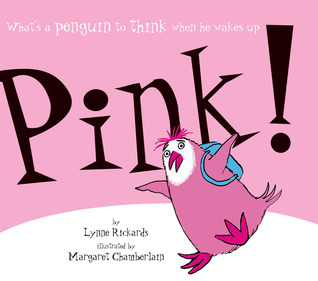
My one-year-old pulled two books from the library shelf at random for me this week.  As it turns out, both books are about homosexual penguins.


Well, no, not really.  He's just pink.  I suppose this penguin could be gay, but the book doesn't go there.  Too bad.

Anyway, in What's a Penguin to Think When He Wakes Up Pink, sweet little penguin Patrick wakes up a new and interesting color.  His friends tease him, so he runs away to Africa to meet pink flamingos.   Due to him being a short-legged and flightless penguin, he doesn't fit in well with the flamingos.  So Patrick swims home again, only to find that his friends all think he is awesome now because he went all the way to Africa and met flamingos.

It's a heartwarming story about how it can be both challenging and neat to be different, and about how boys shouldn't fear the color pink.  I would classify it as too uncontroversial for my collection of dangerous books, but I actually did once overhear a parent at a daycare scold their son not to play with the tea set.  I'm sure that such a parent would disapprove of Lynne Rickards' sweet pink penguin tale, so for them, I add Pink to my library.


Now THIS book really is about gay penguins!  And what a wonderfully sweet book it is.  Based on a true story, two male penguins in the Central Park zoo court each other and build a nest.  A zookeeper gives them an egg to hatch, and the resulting fluffy chick is named Tango.  The end, happy happy.

Being as this is a picture book about a homosexual relationship, And Tango Makes Three, by Justin Richardson and Peter Parnell, was the most challenged book of 2006, 2007, 2008, and 2010.  It was the second most challenged book of 2009.

I read this to my four-year-old.  His only point of confusion: "what's a penguin house, mommy?  I thought they lived in a nest.  Where is the house?"

Sunday, November 25, 2012

Children's Books that Lack Happy Endings

For today's disturbing-and-fascinating children's literature, I present two parables.


Although I found Fox by searching for "most hated children's books", I jumped in with both feet by reading it to my four-year-old in the bedtime-reading lineup.  That was, perhaps, a mistake.  I could feel his discomfort by the second page.  At the end he was about to explode into dismayed questions, and I was not prepared at that late hour to turn Fox into the proper lesson that it needed to be.  I was forced toreach for some standard fluff book as a distraction.

That said, Fox is now on my wishlist.  It is a parable so deliciously and horrifyingly dark that I boggle to think a publisher was willing to risk it.  Good for them!  If there is room in the picture book world for this, then there is certainly room for what I want to write about.

Here is the spoiler:

A one-eyed dog rescues a bird from a fire.  She is so burned that she can never fly again.

This tragedy happens by the second or third page.  Already by this point my son was squirming with discomfort, and so was I.

The dog and the bird become the closest of friends.  Together, they run!  The bird sees for the dog, and the dog's running becomes the bird's flight.

The writing is absolutely touching, by the way.  Margaret Wild had me by the heart.  But even these feel-good bits were flooded with tragedy of Greek proportions.

Then along comes the fox, who is enthusiastically welcomed into their friendship by the dog.  But the bird fears the fox, and the dog ignores her fears.  The fox then drives a wedge into the friendship by secretly whispering to the bird that he can run faster with her than the dog can.  Ultimately, hurt by the dog's ignoring of her fears, she gives in and goes for a ride on the fox.  He runs and runs, dumps her far away in a desert, and leaves her with a nasty comment about how she will now get to understand the fox's loneliness.

The bird contemplates giving up and dying on the spot.  (And this is a picture book!)  But then she thinks of how lonely her friend the dog must be.  And so she resolves to find her way back home.

After having read this as a bedtime story to a child who was not yet ready for its deep themes, I can't help but think that Fox is a fire hose among squirt guns.  It is an immensely powerful parable that does not make any attempt to spell out what lesson the reader should take from it.  I would argue that Fox would be best when used as a teaching tool, read out loud by an adult who is armed with a lesson plan, or at the very least who is armed with some time to answer questions.

As with the other disliked children's parables I have dug up, this story could be interpreted several ways.  But I can't help but be amused and horrified at what seems like the obvious interpretation: Fox is about adultery.


Given my parents' love of Shel Silverstein, I am surprised that I never read this one as a child.  Lafcadio, the Lion Who Shot Back, by Shel Silverstein is practically an illustrated children's novel, at well over 100 pages

Look how vulnerable that lion looks!  I haven't given Silverstein enough credit as an artist.  That's a picture of Lafcadio the lion realizing for the first time that he is naked.  But it also sums up the way a reader is left feeling at the end of the book.

Spoiler:

Lafcadio is a wild and innocent lion who eats a hunter, picks up his gun, and learns to shoot.  A man from a circus recruits him, and Lafcadio subsequently becomes rich and famous in the human world.  Lafcadio learns to walk, dress, and eat, and live like a human.  Ultimately he and everyone around him forgets that he is a lion.  Lafcadio becomes jaded and weary of his experiences, and ends up back in Africa as a hunter of lions.  One of the lions reminds Lafcadio of who he really is.  Suddenly, Lafcadio fits in to neither world.  He runs away and is never seen from again.

Gulp!  It's a fun little ride up until the lion's disenchantment with his human life.  Is this a cautionary tale about forgetting one's roots?  Surely if I had read this as a child, I would have mulled over it for years, and likely my conclusions would have had a profound impact on me.  Here is what Silverstein himself has to say about happy endings:

“Happy endings, magic solutions in children’s books create alienation in the child who reads them. The child asks ‘Why don’t I have this happiness thing you’re telling me about?’ and comes to think when his joy stops that he has failed, that it won’t come back.”

There is a spectrum in children's literature.  On one end are the comfort books - those fluffy things you can grab at bedtime to sooth the kids to sleep.  On the other end are the stories so disturbing that a child will hide a book or lock it in a cage in order to prevent themselves from being subjected to it again.  Adventure or didactic tales are more likely to end up nearer to the disturbing end of the spectrum.

Of course, a story that is just disturbing enough to be exciting for one child can well be beyond the pale for another.  As much as I am intrigued by these outliers in the picture book field, I don't believe that a story with a happy ending is inherently the bad thing that Silverstein considered it to be.  I think a story can be lasting and profound without pounding its readers into a quivering emotional heap.  I'll have to keep my eyes peeled for books that offer a bumpy ride with a nice soft pillow at the end.

Monday, November 5, 2012

Some Parental Discretion Advised.

So.  In order to clarify my thoughts on this post, popped over to dictionary.com in order to learn once and for all the difference between an allegory and a parable.  And I find the definition of a parable begins: "a short allegorical story. . ."

That explains why I was confused on the subject.

The reason I was pondering parables and allegories was because I have been pondering edgy, creepy picture books, among which my own manuscript will likely be lumped by some.  Chief among such stories is the perennially popular The Giving Tree, by Shel Silverstein.


Silverstein was the author of several volumes of children's poetry that children adored but which frequently bothered adults.  If you recall the Johnny Cash song "A Boy Named Sue", those lyrics were his work.  In the Giving Tree parable. . . allegory?  In this tale, a tree is friends with a boy, and together they are happy.  In their continued search for happiness as the boy grows into a man, the tree gives him every last part of herself, at his request, until she is nothing but a stump. Then the boy - now an old man - sits on her.  Sits.  "And the tree was happy."  Shudder.

The Giving Tree became popular back in the sixties in part because it was promoted through church sermons.  To this day, churches present The Giving Tree as an entirely positive parable - there's that pesky word again! - with the tree representing God or Jesus, selflessly giving and giving and giving.

As an adult rereading Silverstein's book, I can't help but see the story as being something entirely different: a picture book warning about the dangers of adultery.  Talk about inappropriate children's book material!  The tree is the other woman, blinded with love, giving her life to a man who is taking and taking but who has another life elsewhere.  Or the tree is the devoted wife, giving and giving her life to a man who squanders his his love on another woman.

The problem is that the Giving Tree is entirely devoid of any guidelines on how it should be interpreted.  It is a hollow shell that can be used to teach whatever lesson the teacher or parent or gift-giver wishes to invest in it.  Religion?  Check.  Parenting?  Check.  Environmental abuses?  Check.  Pick your issue and load it into the Giving Tree like a bullet in a gun.

But what happens when a child reads this book and is given no guidance?  Most picture books are not open to interpretation.  Either the book tells a story - with a happy ending! - or it teaches a lesson - with a happy ending!  But rarely is a picture book story open to any sort of interpretation.  In those books which are not entirely pablum, the child reader is typically led by the nose to the conclusion the author wants them to reach.

The Giving Tree gives the child reader the opportunity to ponder, widely and deeply - as I did, for many years, trying to mentally make the Giving Tree fit in with all the other picture books of my childhood.  The single clue I had to guide my interpretation was that the book was not kept on the bookshelf in my room, with all of the other picture books.  The Giving Tree sat on the living room shelf, looking oddly out of place between the works of Shakespeare and Kahlil Gibran.  Apparently my parents didn't know quite what to make of it, either.  Given that it was an expensive and new edition, in a house otherwise filled with the free things my parents had acquired during their tenure as broke college students, I imagine it was given to them as a gift.

Perhaps it was handed to them when my mother was pregnant.  Because, apparently,  it is considered good taste to traumatize pregnant women with a story that hints that the way to be a good mother is to completely and entirely sacrifice one's self.  (Please excuse me while I vomit into my coffee mug.)

My childhood interpretation of the Giving Tree?  It was a warning against poorly-balanced relationships.  And it was creepy.  And I imagine that was why it lived in seclusion in the living room.  Books and gifts were sacred things to my parents, so they wouldn't have given it away, even if they disagreed with it.

So, do I now let my copy of  the Giving Tree lurk among the kids' shelf of toothless fluff, in the hopes that it will give them something to meditate on when they have forgotten all the other books?  After all, it was so educational to me.  Or, out of dislike for the way it has been used against mothers, and by churches, and in promotion of unhealthy relationships, should I keep it separate?

The solution: I will compile a library of dark and subversive picture books!  After all, these are the picture books that spark my interest the most as an adult.  The books will live in my studio, and come out to play when the kids are ready for a challenge, and when I am available to take their questions.  Some parental discretion advised.


Tuesday, October 9, 2012

Red Wings, Part 2

I have to admit, when a children's book makes my brain churn as much as The Little Rabbit Who Wanted Red Wings, I have to love it, even if I loathe my interpretation of its message.

Yesterday I wrote about my own hissing dislike of Red Wings.  RebeccaFrog, who had introduced me to the book, left some delicious comments in reaction to my reaction.  Completely unrelated, she also drew my attention to a  "cute" little picture being passed around Facebook: a sweating rhinoceros, on a treadmill.  Behind the rhino, taped to the wall, is a picture of a unicorn.

The rhinoceros picture alone is a tragically poignant and humorous summing up of our culture's attitudes towards beauty: we torture ourselves to look like starved supermodels who themselves are Photoshopped to be more thin and lovely than nature can manage.  But the real kicker was the caption on the image: "Never give up on your dreams."

Before I touch that, let me flip over to a fragment of an interview I caught on public radio some months ago.  The scientist being interviewed had spent time studying happiness in America.  He had data showing that our typical happiness over time takes a walloping nose dive when we are in our twenties.  Then it goes up again.  There might have been dips in the teen years and at midlife-crisis time, but I do recall with certainty that the major dip corresponded with the transition from life as a college student to life as a real adult.  And after that point, happiness went mostly up, and up, and up.

And what happens to us when we get out of college?  We get a job, get married, have kids; and we face the ultimate dark truth that we can't be the astronaut or the rock star or famous artist that we had fixated on being for so very long.  But then we reset our goals: get a promotion, go to the beach with the family, buy a house.  Once our goals are no longer out of reach, we become happy again.

 The notion that we, as rhinoceroses, should never give up trying to be the mythical unicorn is a recipe for a future in therapy.  If you make the achievement of an unreachable goal the necessary step to becoming happy, then you will by definition never be happy.  And yet our society places an emphasis on binding happiness to the achievement of goals.

But the flip side of our culture are the cultures around the world that do place an emphasis on finding happiness in what you are given.  But so often these cultures involve gross inequalities and human rights abuses.  It is one thing to find a zen peace in accepting that you will never get to ride on the space shuttle; it is quite another to ask a child bride to find joy in the abusive relationship she has been put into against her wishes.

But here is another complication: people appear by and large to be happier when they make an irreversible decision than when they are permitted to change their minds.  Once again, this comes from an interview I caught on public radio that, dang it, I have no link to.  Sorry!  There was a study involved, and the implications were creepy.  (Which college?  Which career?  Career or family?Divorce! Abortion!)  The author of the study went on a bit about how we tie our happiness to achieving our goals, and how as a culture we don't like to admit that we can also successfully convince ourselves to be happy when we fail to reach our goals.  And the reason we don't like to go there is because we see that sort of happiness as being fake.

I'm as indoctrinated as the rest of my generation of goal-seeking affluent white Americans, so when I see a story from 1945 about a bunny who gives up on a dream to instead accept his lot in life, my reaction is to hiss at it.

My more delayed reaction is to put the book on my Amazon wishlist.  I do believe I want a copy of The Little Rabbit Who Wanted Red Wings on my shelf.  It will sit right next to The Giving Tree, which will be the topic of a future blog post.  Red Wings isn't necessarily one I will pull out to read to my kids, but it will be on my mind as I try to figure out what stories I can tell that will help guide future generations to neither entirely accept their lot in life, nor tie their happiness to the achievement of shoot-for-the-moon goals.

Monday, October 8, 2012

Red Wings


Some years ago, in the BC era (Before Children), I was wandering the back rooms of an antique store with a friend when she picked up a copy of the little book pictured above, gave a squee of joy, and shared her fond memories of having read it as a child.  I loitered in that room and read the book.  There was no squee for me.  The book gave me cold chills.

I still feel guilty for wrecking my friend's fond memories of this book.  Having grown up with it, and not having seen it since her childhood, she did not see the dark side of this outwardly charming tale.

I'm afraid that the book doesn't exist in my otherwise extensive library system, so my retelling is based entirely upon that one very quick read there in that dusty antique shop.  The Little Rabbit who Wanted Red Wings, by Carolyn Bailey, is about a baby bunny who longs for a pair of red wings.  Against the advice of mommy bunny, he, or possibly she, gets those wings, and discovers that life with wings is rather awful.  Nobody recognizes him.  He ultimately gives up the wings and goes back to being a generic baby bunny.

I can see how this would be a cute and happy read to a child.  I can also see how such a story - published in 1945 - would help to guide little girls gently into their expected roles as future housewives and mothers.  Or nudge little boys to follow their fathers' footsteps into the factories or mines.  Or indoctrinate black children so that they wouldn't get uppity ideas into their heads.  And all of this is done so gently and cheerfully!  Because obviously teaching children to aspire to great things or different things or difficult things can lead to - oh no! - bad experiences!  We wouldn't want those bad experiences in our children's soft and cozy futures, now would we?  We wouldn't want our darling baby bunnies to grow up into fascinating people whom we don't recognize, now would we?

I must admit, Red Wings stung me doubly because since my earliest childhood, wings have been a potent symbol to me of my own future freedom.  As I progressed from grade school to middle school to highschool, my educational track pushed me deeper and deeper into misery.  I fantasized about dragons and winged unicorns, about my hundred-pound backpack turning into wings, about growing wings to save me from falling when the cliff of graduation finally came along.  I was seven years old in 1985 when Mr. Mister released the song Broken Wings, which echoed through my childhood and is possibly to blame for my wing obsession: take these broken wings/ and learn to fly again/ learn to live so free.  Had I read The Catcher in the Rye during my teen years, I would have added wings in my mental image of the drama out there on the rye field.  Instead, I painted pictures of dragons chained in dungeons, or with torn wings.

I finally did find my wings as an adult, in the form of a career making art for games, in (finally) dating and falling in love, in having the free time to paint and play and choose my own path. I have even jumped out of an airplane in exploring what my wings can do.  Twice!  I am in love with my metaphorical wings!

If I succeed in getting my current manuscript published, I hope that some graduate student out there will analyze it, because I have taken all of this wing business and folded it up and crammed it in there.  I would like to get the wing metaphor over with so that I can move on to telling stories about topics other than dragons and wings.  At least some of the time.

Perhaps someday I'll even write a story about bunnies.